For health ministry officials, hospital procurement committees, and aid organization logistics directors across Africa, the Middle East, and Southeast Asia, optimizing limited public health budgets to maximize emergency medical services (EMS) efficiency is a critical challenge. A central decision in fleet planning is choosing between Advanced Life Support (ALS) and Basic Life Support (BLS) ambulances. The wrong choice can lead to wasted resources, idle equipment, or a critical gap in lifesaving capabilities. This guide provides a clear, objective comparison to empower your strategic procurement decisions based on local needs.
Before diving into the comparison, it's essential to understand their core purposes.
BLS (Basic Life Support) Ambulance: The primary mission is "Stabilization and Transport." It is equipped for non-invasive procedures aimed at maintaining a patient's vital signs and ensuring their rapid, safe transport to the nearest appropriate medical facility. It forms the backbone of any EMS network, emphasizing accessibility and coverage.
ALS (Advanced Life Support) Ambulance: The primary mission is "Mobile Treatment Unit." Functioning as a "mobile ICU," it is equipped for invasive procedures and advanced therapies. Highly trained personnel can begin complex medical interventions at the scene and en route, buying critical "golden hour" time for severely ill or injured patients.
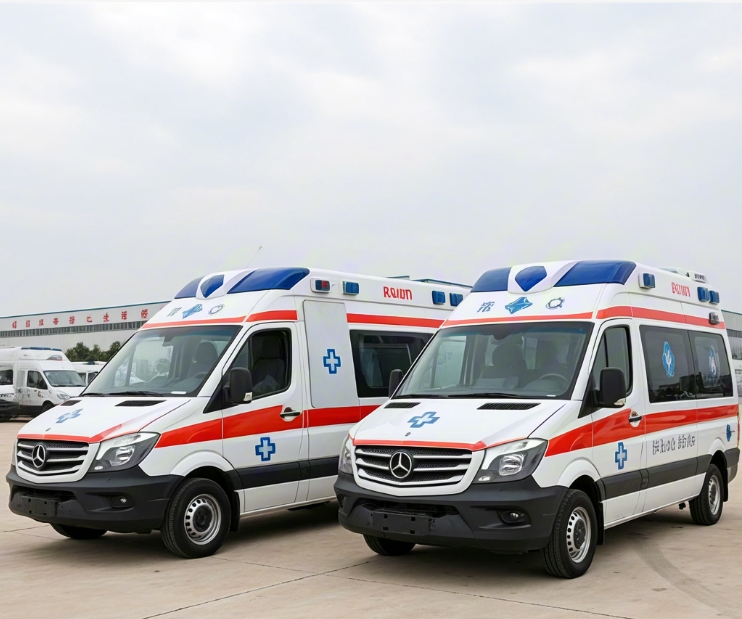
The following table provides a clear, at-a-glance overview of the key differences:
| Dimension | BLS (Basic Life Support) Ambulance | ALS (Advanced Life Support) Ambulance |
|---|---|---|
| Core Mission | Safe Transport & Basic Life Sustenance | Mobile Treatment Unit & Advanced Intervention |
| Medical Equipment | Oxygen administration, suction unit, stretcher, AED, basic splinting & bandaging materials | Includes all BLS equipment, plus: Cardiac monitor/defibrillator, ventilator, infusion pumps, advanced airway management equipment, comprehensive drug kit |
| Crew Requirements | Emergency Medical Technicians (EMTs) | Paramedics, Critical Care Nurses, or Physicians |
| Typical Use Cases | Non-emergency patient transfers, low-acuity calls, community first response, event medical coverage | Cardiac arrest, major trauma, strokes, respiratory failure, severe burns – life-threatening emergencies |
| Procurement Cost | Lower (Cost-effective vehicle and equipment package) | Significantly Higher (High-cost specialized medical equipment drives up price) |
| Operational Cost | Lower (Simpler consumables, easier maintenance) | Substantially Higher (Regular device calibration, expensive medical consumables, ongoing advanced training) |
The choice between ALS and BLS is not about "good vs. bad" but about "appropriate vs. inappropriate." Your decision should be guided by these strategic factors:
Budgetary Constraints:
For regions with tight budgets, the most pragmatic strategy is a mixed fleet: a core of BLS ambulances for broad coverage, supplemented by a few strategically placed ALS units in major urban or regional centers. This model ensures service breadth while retaining deep treatment capability where it's most needed.
Infrastructure & Geography:
Accessibility in the "last mile" is paramount. In areas with underdeveloped road networks or rugged rural terrain, a BLS ambulance on a rugged 4x4 chassis that can reach a patient is infinitely more valuable than a sophisticated ALS ambulance that cannot. Always prioritize vehicle reliability and off-road capability.
Staff Training & Availability:
Training must precede procurement. Investing in ALS vehicles is only viable if you have—or can quickly train—a cohort of qualified Paramedics. Without this human resource, ALS equipment lies unused, representing a massive waste of capital. BLS staff (EMTs) have shorter, more cost-effective training cycles, enabling rapid EMS network expansion.
Disease Profile & Epidemiology:
Analyze your region's most common emergency needs. For cases like malaria, diarrheal diseases, obstetric complications, and basic trauma, BLS often provides sufficient stabilization and rapid transport. In urban areas with a higher incidence of cardiovascular disease, the advanced capabilities of an ALS unit are crucial. Let your disease burden data drive your procurement strategy.
Q: Is an ALS ambulance always better? Shouldn't we always buy the most advanced option?
A: Absolutely not. The most advanced equipment has zero value if it cannot reach the patient promptly. The most appropriate solution for your local context is the best one. A BLS unit that can reach a remote village on time saves more lives than an ALS unit stuck in urban traffic. The correct strategy is about matching resources to needs, not about追求 technological superiority.
Q: Can we purchase a BLS ambulance and upgrade it to an ALS standard later?
A: This is a viable strategy, but it requires forward planning. The vehicle chassis and module form the foundation. The core differences lie in the medical equipment and the electrical system (ALS requires a higher-capacity inverter to support power-hungry devices). Therefore, when procuring BLS ambulances, opt for a modular design that pre-wires for future upgrades and Reserve space for additional equipment, effectively future-proofing your investment.



 Ambulance


